A screenshot of a fictional page on the BayernKI website with the heading “Questions and Answers”.

First BayernKI Q&A Session

Current and future users of BayernKI resources for science can join the first BayernKI Q&A Session!

We are pleased to invite you to our first BayernKI Q&A Session, jointly organized by NHR@FAU and LRZ. It takes place on Wednesday, June 4 from 1:00 to 2:00 p.m. This online session will recur on the first Wednesday of every month, providing a regular opportunity…


Replacing AI training with Math Methods

Artificial neural networks are becoming increasingly large and complex – and therefore require more and more energy for training with data. A research team led by Felix Dietrich, Professor of Physics-Enhanced Machine Learning at the Technical University of Munich (TUM), is working on replacing training steps with mathematical methods. This reduces power consumption and helps to better understand how artificial intelligence (AI) works…
The picture shows a desk and the hands of a person working on two different computers. One is a desktop PC showing an AI chat program, the other is a laptop on displaying code.

HPC Café on May 13: LLM Prompting for Passion: Free Yourself from the Busywork

Our next HPC Café will take place on Tuesday, May 13, 2025, at 4:00 p.m. as a hybrid event, again evolving around the topic of AI. This time, our NHR@FAU AI support member Sebastian Wind will give you an overview of prompt strategies. We invite you to visit us at NHR@FAU to enjoy coffee, cake, and computing, or join via Zoom.
The image of a cup of cappuccino next to a laptop. In the foreground are the logos of the HPC Café Erlangen and BayernKI.

This month’s HPC Café on April 8 is all about BayernKI

NHR@FAUs next HPC Café will take place on April 8 at 4:00 p.m. as a hybrid event. As always, there will be plenty of time to get in touch with your favorite HPC group. We invite you to come to NHR@FAU to enjoy coffee, cake, and computing. The event starts at 4:00 p.m. CEST with an open coffee chat, and at 4:30 p.m., we will start the presentation.
the image of a person working on a laptop with focus on their hands. The inscription “Chat AI” can be read on the screen and a stylized chat program can be seen.

Monthly HPC Café Goes AI (March 11, hybrid)

NHR@FAUs next HPC Café will take place on March 11 at 4:00 p.m. as a hybrid event. As always, there will be plenty of time to get in touch with your favorite HPC group. We invite you to visit us to enjoy coffee, cake, and computing. The event starts at 4:00 p.m. with an open coffee chat, and at 4:30 p.m…

AI Day at the University of Bayreuth

On February 7, 2025, the AI Day took place at the University of Bayreuth – an inspiring event with exciting lectures, practical presentations and lively discussions about artificial intelligence and data science. Scientists and experts from business and research came together to discuss current developments, use cases and challenges in this dynamic field.

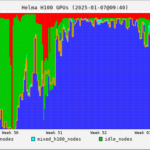
“Helma” already records massive workload

Early access to the new “Helma” AI cluster at NHR@FAU is in progress and already recording high usage and massive workloads on the system. The first half of the supercomputer is currently in an intense testing phase and will go into open access in the first half of 2025. As the monitoring visualizes, the capacities of the system were almost fully used on January 7…

“Blue Lion”: HPE to build next supercomputer at LRZ

The new supercomputer “Blue Lion” is part of the German national HPC infrastructure of the Gauss Center for Supercomputing and will serve a wide range of research projects, combining classic simulations with artificial intelligence. Please read the press release of HPE. Blue Lion is scheduled to go live in early 2027 and deliver 30X faster performance…
A black background with colorful speech bubbles, containing censored insults and curses.

AI technology to fight Online Harassment faster

With the CS-2 system from Cerebras, AI models for the recognition of hate speech on social media platforms can be trained faster, and offensive texts can be detected more effectively. This is shown by a study from the LRZ that compares different AI accelerator systems. Identifying hate speech and removing it from the digital world: This is a task…